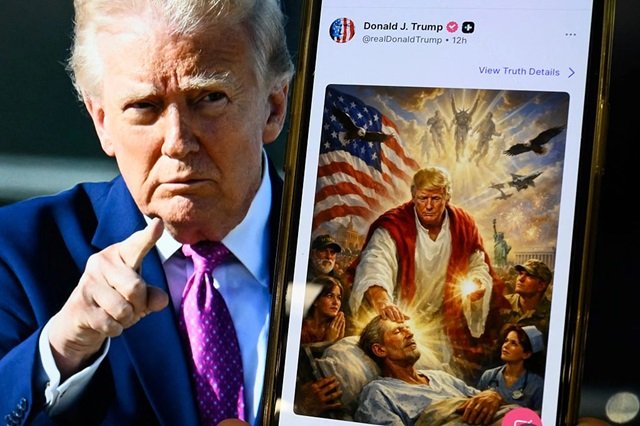
A growing backlash is unfolding across the United States as President Donald Trump faces rare and vocal criticism from within Christian and particularly Catholic circles, after a series of provocative posts in which he appeared to associate himself with Jesus Christ while intensifying his attacks on the Pope. What began as an online controversy has quickly evolved into a broader political and religious dispute, exposing fractures within a coalition that has been central to Trump’s electoral success.
The latest incident came when Trump reposted a meme on his social media platform depicting Jesus embracing him, accompanied by a message dismissing critics as members of the “Radical Left.” The image followed closely on the heels of an earlier post—since deleted—in which an AI-generated portrayal showed Trump in messianic form, healing the sick while surrounded by angels and military imagery. Although the president later downplayed the post, claiming he saw himself depicted as a “doctor” rather than a divine figure, the damage had already spread far beyond his usual political opponents.
Religious leaders and conservative commentators, many of whom have historically supported Trump, were among the first to condemn the imagery. Catholic bishops from dioceses across the country, including Oklahoma, Chicago, and Las Vegas, issued public rebukes. Archbishop Paul Coakley, president of the United States Conference of Catholic Bishops, emphasized that the Pope “is not a rival” to political leaders but a spiritual authority concerned with the moral guidance of the faithful.
The criticism extended into conservative intellectual circles. Writer Rod Dreher, a prominent Christian commentator, warned that Trump’s rhetoric risked invoking dangerous theological symbolism, stating that while he would not label the president as the Antichrist, his actions reflected what he described as its “spirit.” Such language, once confined to fringe discourse, has gained visibility in recent years amid a resurgence of apocalyptic and religiously charged narratives in American politics.
Even grassroots supporters expressed unease. Activist Riley Gaines, known for her alignment with conservative causes, cautioned on social media that “God is not to be mocked,” highlighting the discomfort among segments of Trump’s base who see religious imagery as sacred rather than political.
The controversy comes at a delicate moment in Trump’s relationship with religious voters. His political success has long depended on strong backing from Christian constituencies, including evangelical Protestants and Catholics. In the 2024 election, exit polls indicated that 62 percent of Protestants and 55 percent of Catholics supported his candidacy, underscoring the importance of faith-based alliances in his electoral strategy.
However, the emergence of Pope Leo XIV, the first American pontiff in history, has complicated that dynamic. Born in Chicago, the new Pope initially enjoyed greater acceptance among conservative Catholics than his predecessor, Pope Francis, whose tenure was marked by tensions with parts of the U.S. Church. Yet Trump’s recent remarks have triggered an unusually direct confrontation.
The president dismissed the Pope as “not a great fan,” accusing him of being soft on crime and aligned with left-wing politics. Pope Leo XIV, speaking during a trip to Africa, responded firmly, stating that he was not intimidated by the Trump administration. The exchange escalated further when Trump demanded publicly that the Pope acknowledge Iran’s alleged murder of thousands of protesters, linking the issue to broader geopolitical tensions and nuclear concerns.
These clashes have drawn in other influential figures within Trump’s political orbit. Vice President J. D. Vance, himself a Catholic convert, suggested during a public event that the Pope should exercise caution when addressing theological matters, echoing a broader Republican argument that religious leaders should avoid political engagement. His remarks were interrupted by audience members, reflecting the charged atmosphere surrounding the debate.
Vance has previously sparred with the Pope—known before his election as Robert Prevost—over interpretations of Catholic doctrine, particularly on immigration. The vice president has argued that Catholic teaching can support stricter immigration policies, a position the Pope has publicly challenged as a misreading of Christian love and moral responsibility.
The controversy has also reignited scrutiny of Trump’s own relationship with religion. Despite establishing a White House Office for Faith during his second term, the president has often been criticized for his limited familiarity with theological concepts. His use of artificial intelligence to create religious imagery, including depictions of himself as the Pope, has further fueled perceptions that he treats faith as a political tool rather than a spiritual commitment.
This perception is reinforced by elements of the broader “Make America Great Again” movement, where merchandise and online content frequently portray Trump in quasi-religious terms. Slogans blending devotion and political loyalty—such as equating faith in Jesus with support for Trump—have become common, blurring the line between religious belief and partisan identity.
The stakes are heightened by the significant presence of Catholics within the U.S. political system. Although they represent about 20 percent of the population, Catholics hold a disproportionate share of political power, including roughly one-third of the current cabinet, more than a quarter of the House of Representatives, and a majority on the Supreme Court.
Whether the current backlash will translate into lasting political consequences remains uncertain. Trump’s career has been marked by controversies that might have derailed other politicians but failed to erode his core support. Nonetheless, the intensity and source of the criticism—coming from within his own ideological and religious base—make this episode particularly noteworthy.
At the same time, the president is navigating declining approval ratings during his second term, adding another layer of vulnerability. The convergence of political, religious, and cultural tensions suggests that this dispute may have implications beyond immediate headlines, potentially reshaping alliances that have defined American politics in recent years.