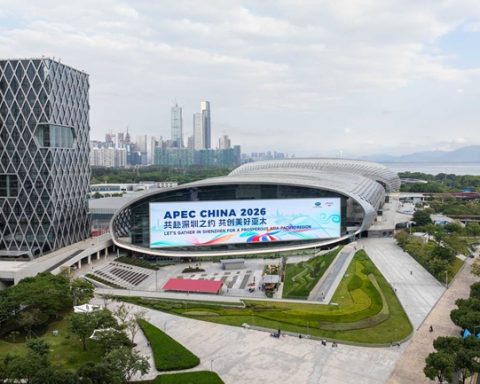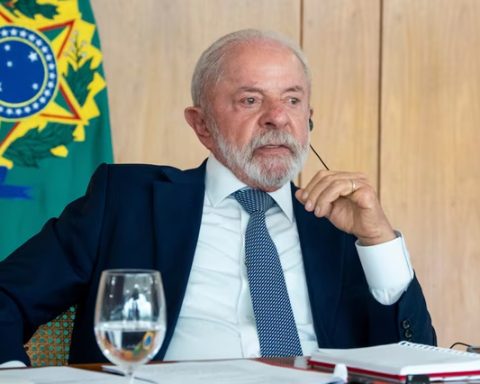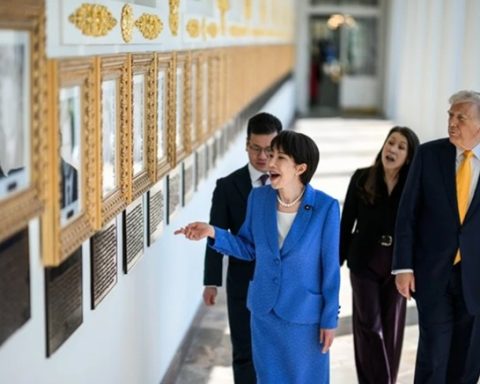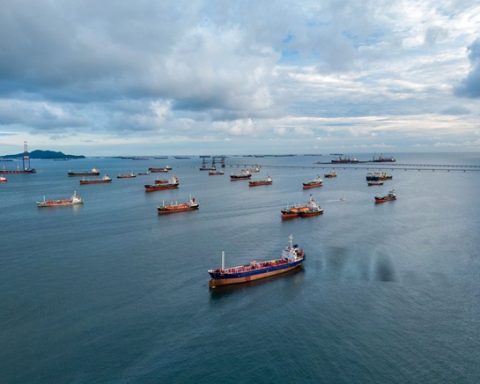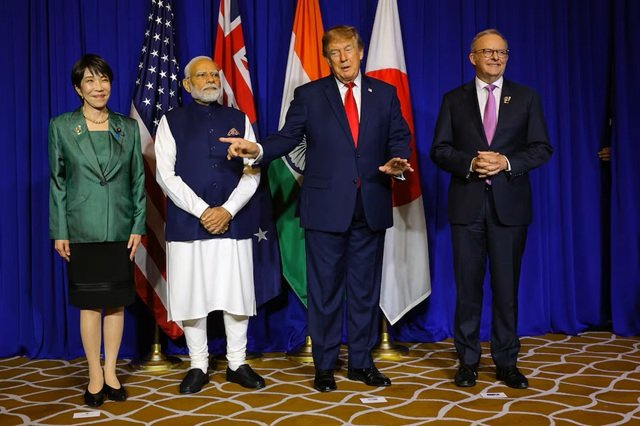
US President Donald Trump met the leaders of India, Japan and Australia in Manila on Tuesday, reviving high-level engagement among the four Indo-Pacific democracies ahead of an anticipated meeting with Chinese President Xi Jinping and Russian President Vladimir Putin later this week. The gathering marked the first meeting of the Quad leaders in two years and opened Trump’s three-day Asian visit, which will also include the Asia-Pacific Economic Cooperation (APEC) forum in Shenzhen, China, according to a Reuters report.
Trump arrived in the Philippine capital towards the end of a summit of the Association of Southeast Asian Nations (ASEAN), beginning his regional engagements with the Quadrilateral Security Dialogue, known as the Quad. The grouping brings together the United States, India, Japan and Australia, which have presented their cooperation as an effort to promote stability and prosperity across the Indo-Pacific.
“Our countries are the four corners of a free, open, stable, and prosperous Indo-Pacific,” Trump said during the meeting.
The diplomatic engagement comes at a sensitive moment for US relations with China, following Republican Party setbacks in the American midterm elections, allegations involving Chinese espionage and new US restrictions on China’s access to advanced artificial intelligence chips. These developments threaten to complicate an already fragile trade-war truce between Washington and Beijing, which is due to expire in January.
The Quad’s joint statement expressed “grave concerns” about economic coercion, including the use of arbitrary export restrictions, without explicitly identifying any country. The United States and Japan have both raised concerns about China’s restrictions on rare-earth exports, which are essential for manufacturing products ranging from electric vehicles to mobile phones. China has effectively halted exports of key critical minerals to Japan for nearly a year as relations between the two Asian powers have deteriorated.
Beijing has also criticised Washington’s latest restrictions on advanced semiconductor technology. China’s Foreign Ministry accused the United States of economic coercion over measures designed to limit Chinese access to advanced chips, adding another point of tension ahead of Trump’s expected meeting with Xi in Shenzhen.
The Quad statement also outlined plans for joint military exercises next year involving maritime patrol aircraft and reaffirmed commitments to an initiative designed to coordinate and finance artificial intelligence development among member countries.
Trump said the AI cooperation was intended to ensure that the future of the technology remained in the hands of countries sharing common interests and values. Indian Prime Minister Narendra Modi described the meeting as providing “fresh momentum” to the group’s shared vision for a free, open, peaceful and prosperous Indo-Pacific, with concrete objectives for future cooperation.
Former US Deputy Secretary of State Kurt Campbell credited Secretary of State Marco Rubio with helping to reconvene the Quad at a significant diplomatic moment. Campbell, co-founder of The Asia Group, said the meeting could send an important signal ahead of the planned trilateral engagement involving the United States, China and Russia on Thursday.
China has previously objected to the Quad, viewing it as an effort to contain Beijing’s influence, while its four members have maintained that the grouping is not directed against any particular country.
Trump’s visit has also drawn protests in Manila. Demonstrations entered their fifth consecutive day, with protesters burning effigies of the US president and calling for an end to the Middle East war and the abandonment of the US-led Pax Silica supply chain initiative.
At the ASEAN summit on Monday, Chinese Premier Li Qiang praised what he described as the “truly extraordinary” economic achievements of China and ASEAN despite global trade restrictions. He called for countries to defend free trade, stand together and resist external interference.
China remains ASEAN’s largest trading partner and a major source of investment. However, the bloc’s largest economies are also seeking stronger economic ties with the United States despite continuing trade and diplomatic uncertainty under the Trump administration.
Japanese Prime Minister Sanae Takaichi pledged on Tuesday to work with ASEAN to strengthen regional economic and energy resilience, including supply chains for critical minerals. “While the international order is experiencing a period of great instability, Japan will play an ever more proactive role,” she said.
Trump also signed a joint trade statement with Thai Prime Minister Anutin Charnvirakul, under which Thailand is expected to eliminate all tariffs on US exports and remove substantial non-tariff barriers. The agreement is expected to be finalised in the coming weeks. The United States is Thailand’s largest export market, accounting for 24% of the country’s total shipments this year.