My mobile telephone rang around noon on 8 December. It was an overseas call from Dubai. The caller was our former Army Commander, General Mahesh Senanayake.
“Sir, have you heard the news? General Rawat and Madam are no more. Helicopter crash!”
Mahesh knew of my close relationship with General Rawat. We had attended the year-long National Defence College (NDC) course in New Delhi in 2010, eleven years earlier.
I switched on the television and tuned in to NDTV. The channel was reporting details of the tragic helicopter crash near Ooty, a few kilometres from the Indian Defence Services Staff College (DSSC) in Wellington, in the Nilgiris district of Tamil Nadu, India.
India’s first Chief of Defence Staff (CDS), General Bipin Rawat, PVSM, UYSM, AVSM, YSM, SM, VSM, ADC, his wife, Mrs Madhulika Rawat, and eleven others, most of whom were members of the General’s personal staff, had perished in the crash. All but one died at the crash site; the remaining survivor later succumbed to his injuries.
We had sixty Indian Army brigadiers attending the course alongside me. I used to sit next to General Rawat in the auditorium as we listened to eminent Indian scholars, retired senior military commanders, diplomats and business leaders. Our friendship extended to our families as well, and my family was once invited to dinner at his residence. Madhulika was a friendly and gracious lady.
Madhulika Raje Singh was a descendant of a former princely family. She was the daughter of Kunwar Mrigendra Singh, a member of the Indian National Congress and a local legislator. She received her education in Gwalior and graduated in Psychology from Delhi University. She married Bipin in 1985, and the couple had two daughters, Kritika and Tarini.
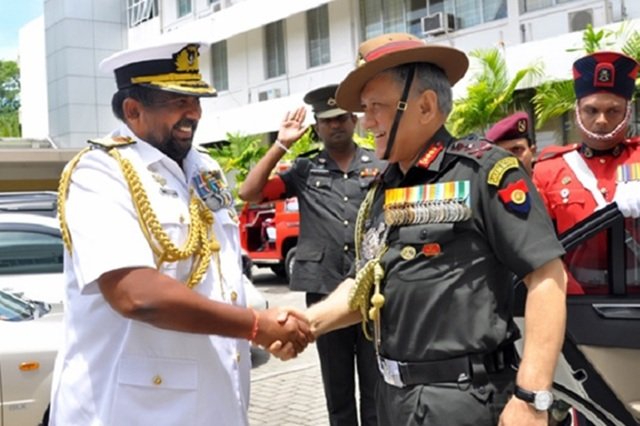
Before being appointed India’s first Chief of Defence Staff, General Rawat served as Chief of the Army Staff for three years. In May 2018, he visited Sri Lanka as India’s Chief of the Army Staff (COAS), at the invitation of our then Army Commander, General Mahesh Senanayake.
I was serving as Sri Lanka’s Chief of Defence Staff at the time. General Rawat made only one request to Mahesh: that the final evening of his visit be kept free so that he could visit my home.
As agreed, I hosted him and Madhulika at my official residence. They were both happy and relaxed. The Sri Lanka Navy band played a selection of beautiful old Hindi songs, which its members had practised under the guidance of my wife, Yamuna. It was a lovely evening, with delicious food, drinks, wonderful company and melodious old Hindi songs. At the end of the evening, General Rawat wanted to thank every member of the Sri Lanka Navy band personally.
When it was time for them to leave my residence, he expressed a desire to see my dog, Rexy, whom he had met during his time in New Delhi. Everyone present that evening was surprised. He remembered the name of a dog he had met eight years earlier in New Delhi. That was the measure of his sharp memory and attention to detail.
Bipin was born on 16 March 1958 in Pauri town, in the Pauri Garhwal district of what is now Uttarakhand. His family had served in the Indian Army for several generations. His father, Lakshman Singh Rawat, served in the 11 Gorkha Rifles and rose to the rank of Lieutenant General, retiring as Deputy Chief of the Army Staff in 1988. His mother was the daughter of Kishan Singh Parmar, a former Member of the Legislative Assembly (MLA) from Uttarkashi.
Having grown up in a military family, with his father having served as Deputy Chief of the Indian Army, the pomp and pageantry of military life were nothing new to him. He was awarded the ‘Sword of Honour’ at the Indian Military Academy (IMA) in Dehradun. He was a true follower of the Chetwode Motto, inscribed in golden letters at the IMA Hall of Fame:
“The safety, honour and welfare of your country come first, always and every time. The honour, welfare and comfort of the men you command come next. Your own ease, comfort and safety come last, always and every time.”
Dear General Sir, you lived up to that promise throughout your life. You remain a role model for all junior officers.
Following your visit to Sri Lanka, you made arrangements for Sri Lankan military personnel and their spouses to visit Bodh Gaya every year. You also ensured that the Indian Air Force’s largest transport aircraft, the C-17 Globemaster, was made available to transport our personnel for this annual pilgrimage. As Buddhists, we deeply appreciate this gesture and remember it with the highest respect.
Ironically, the last gift you sent me, through Vice Admiral Anil Kumar Chawla, former Flag Officer Commanding-in-Chief of the Southern Naval Command, just last month, was a beautiful white marble Buddha statue. It now occupies a prominent place in our shrine room. Whenever my wife, Yamuna, and I see this statue, we will remember General Bipin and Madhulika.
Om Shanti!
The Funeral
There was no time to lose. I decided that I had to attend the funeral of my dear friend and his wife. The media reported that the funeral had been scheduled for 11 December at Brar Square Crematorium in Delhi Cantonment.
I booked a ticket on the SriLankan Airlines flight from Colombo to New Delhi for 10 December. Sri Lanka’s Chief of Defence Staff and Army Commander, General Shavendra Silva, also travelled on the same flight to New Delhi to attend the funeral, representing the Sri Lankan Government. It was a deeply appreciated gesture by the Sri Lankan military at a time when India was mourning this terrible loss. Our CDS sat next to India’s Defence Minister, the Hon. Rajnath Singh, during the funeral parade.
The mortal remains of General Bipin Rawat and Madhulika were placed side by side on a single gun carriage and transported from their official residence at 3, K Kamraj Marg, to Brar Square Crematorium. Around 800 personnel from the Indian Army, Navy and Air Force participated in the funeral parade, led by a Tri-Services band.
During my four years and eight months in New Delhi, serving as Defence Adviser for three years and eight months and spending one year at the National Defence College, I had never witnessed anything like what I saw that day.
Thousands of people carrying the Indian tricolour and photographs of General Bipin and Madhulika followed the funeral procession. The crowds chanted, “Jab tak suraj chand rahega, Rawat ji ka naam rahega” and “Indian Army Zindabad”. Others stood along the roadside, showering flower petals on the passing convoy.
General Rawat was immensely popular among the Indian public, who regarded him as a tough military leader committed to protecting his country with vision and wisdom.
The two daughters of General Bipin and Madhulika performed the last rites of their parents. Seventeen-gun salutes echoed through the air, befitting the most senior serving military officer in India, who had died in uniform. As the funeral pyre burned, their mortal remains were consumed by the flames against the backdrop of a cold Delhi winter.
The following morning, the ashes of General Rawat and his wife were taken to Haridwar and immersed in the sacred River Ganga by their children. Haridwar, whose name is traditionally interpreted as ‘Gateway to God’, is one of Hinduism’s most sacred pilgrimage destinations.
We salute you, General, a dear friend of Sri Lanka.