A groundbreaking study led by Professor WU Qingfeng at the Institute of Genetics and Developmental Biology, Chinese Academy of Sciences (CAS), has revealed key developmental and evolutionary mechanisms shaping the human hypothalamus—one of the brain’s smallest but most complex and vital regions.
Published on April 8 in Developmental Cell, the research offers the first comprehensive integrative analysis of the cellular architecture and evolutionary divergence in the developing mammalian hypothalamus, providing valuable insights into how this critical brain structure underpins human-specific behaviors, physiological functions, and disease susceptibilities.
The hypothalamus governs essential life-sustaining processes including body temperature regulation, hunger and thirst, hormonal signaling, sexual behavior, circadian rhythms, and emotional responses such as fear and maternal bonding. Despite its fundamental role and compact size, the hypothalamus has long remained an enigma in terms of its developmental origins and evolutionary adaptations—until now.
Prof. WU’s team built upon their previously proposed “cascade diversifying model,” which suggests that the hypothalamus generates its vast neuronal diversity through a stepwise process involving neural progenitors, intermediate progenitors, and nascent neurons. In this latest study, the team traced the emergence of different cell types from these progenitors and identified both conserved and human-specific genetic features across species.
“This study advances our understanding in three important ways—methodologically, conceptually, and as a valuable resource,” said Prof. WU. Using advanced tools like single-cell and single-nucleus RNA sequencing, spatial transcriptomics, and computational modeling, the researchers created a detailed spatial map of progenitor cells and gene activity in the developing hypothalamus of humans and mice.
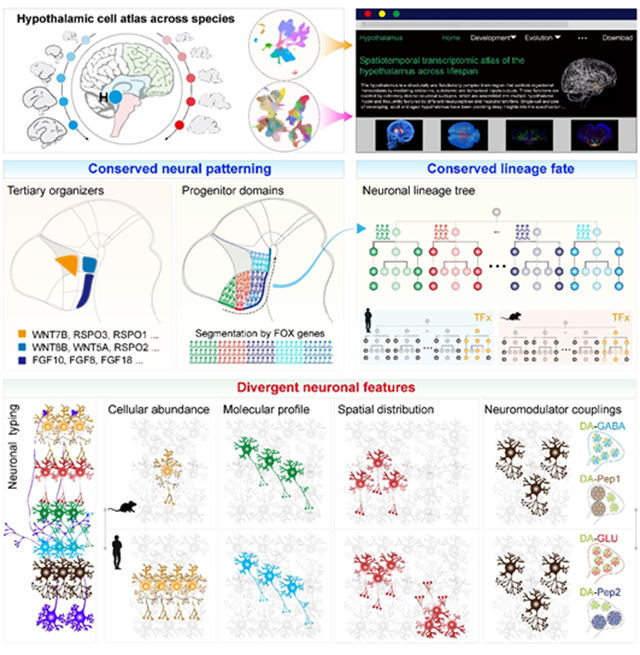
Conceptually, the study identified three conserved “tertiary organizers”—morphogenetic centers that send out molecular signals to orchestrate the hypothalamus’s regional development. This anteroposterior segmentation was linked to the activity of FOX family genes, illuminating a fundamental neural patterning strategy shared across mammals.
In terms of evolutionary innovation, the team uncovered four major divergences in the developing human hypothalamus:
- A previously unknown neuronal subtype enriched in humans, whose role remains to be understood.
- An enhanced neuromodulatory profile, with increased expression of genes involved in ion channel regulation, neuropeptide signaling, and receptor activity.
- Redistributed neuroendocrine neurons, such as GnRH and GHRH cells, suggesting a reconfiguration of the human neuroendocrine system.
- Rewired neurotransmitter coupling in dopamine neurons, revealing species-specific patterns of co-transmission and neuropeptide interaction.
These findings may explain evolutionary differences in behaviors such as reward learning, stress response, body growth, and reproductive function. The study’s cross-species comparisons—enabled by machine learning frameworks and transcriptomic datasets—shed light on how human hypothalamic neurons adapt structurally and functionally to support advanced cognitive and social capabilities.
“The hypothalamus may be small, but its complexity is immense,” noted Prof. WU. “Our findings suggest that while the human brain retains deeply conserved neural patterning strategies, it also evolves in very targeted ways to meet the unique demands of our species.”
Backed by the Chinese Academy of Sciences and conducted at its prestigious Institute of Genetics and Developmental Biology, this research not only deepens our understanding of human brain evolution, but also holds promise for unraveling the cellular basis of neurological and psychiatric conditions with hypothalamic involvement.
This work was supported by major national funding bodies, including the National Natural Science Foundation of China and CAS projects aimed at advancing frontier life sciences. With its integrative approach, the study positions China at the forefront of developmental neurobiology and evolutionary neuroscience.