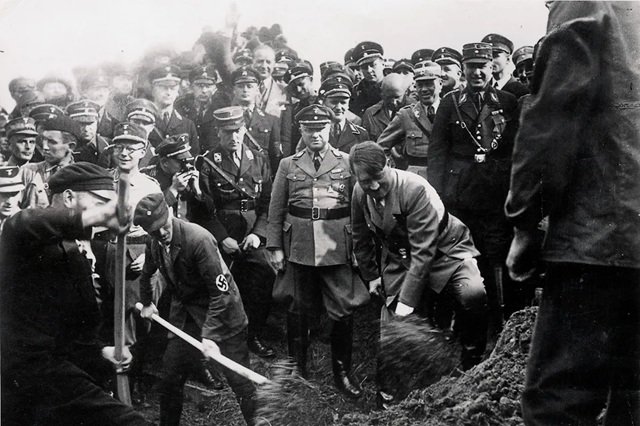
When Max-Erich Feuchtinger died in 1960, he was remembered as one of West Germany’s leading transport planners. His designs had shaped the reconstruction of bombed-out Ulm, while he had planned motorways near Cologne and across the Brenner Pass. In Stuttgart, he helped move parts of the tram network underground and served as director of the Institute for Traffic Engineering at the city’s university. One obituary called him the “king of his field”.
For decades, the professional establishment treated him accordingly. The Research Association for Roads and Transport, known by its German initials FGSV, established a foundation in his name in 1970 and commissioned a commemorative medal. A prize for young engineers was awarded in his honour every two years, most recently in 2024. In a commemorative publication, the organisation praised Feuchtinger’s “outstanding personality” and “unmatched professional achievements”, expressing the hope that the foundation would make him “immortal”.
That legacy is now being reassessed. Documents from the Norwegian National Archives, Feuchtinger’s denazification file and FGSV records examined by DER SPIEGEL show that the engineer was deeply involved in the Nazi regime’s forced-labour system. During the Second World War he served as an Oberfrontführer in Organisation Todt, the Nazi construction organisation whose projects relied extensively on prisoners of war, concentration-camp prisoners and labourers from occupied territories. Under Feuchtinger’s supervision, prisoners in Norway worked on roads and railway lines, with thousands dying in the process. One of the routes is still known in Norway as “Blodveien”, or “Blood Road”.
Feuchtinger was 23 when Adolf Hitler came to power in 1933. Born in Kiel, he had just passed his diploma examination at the former Technical University of Berlin and wanted to become a government construction official. That autumn he applied to the Sturmabteilung, or SA. In his postwar denazification proceedings, he claimed that Nazi legislation had effectively forced state-service applicants to demonstrate political reliability. The law he cited, however, contained no such wording, although Nazi authorities did make clear that membership of the NSDAP or one of its affiliated organisations could improve applicants’ chances of obtaining state employment.
Feuchtinger became a government construction trainee in Potsdam in 1934 and developed an intense interest in motorways. The FGSV later described him as an “absolute motorway fanatic” who drew proposed routes by hand on maps of Germany. His career was supported by official institutions: the Prussian Finance Ministry and the Association of German Engineers helped finance study trips to Canada and the United States, while Stuttgart’s university contributed towards printing his doctoral dissertation. After the NSDAP relaxed its membership freeze in 1937, Feuchtinger joined the party. A year later he passed the state examination “with distinction” and became a Regierungsbaumeister.
His career then moved increasingly into the machinery of Nazi wartime construction. Organisation Todt, established under engineer Fritz Todt, built bunkers, roads, railway lines and bridges for Hitler’s military campaigns. By 1944 an estimated 1.5 million people were working simultaneously for the organisation. Conditions varied, but forced labourers were subjected to hunger, violence, exhaustion and inadequate shelter. Historian Christian Packheiser of the Institute for Contemporary History in Munich told DER SPIEGEL that death rates could be particularly high when Organisation Todt assumed sole responsibility for a project.
Norway became a major construction zone after Germany occupied the country in April 1940. In 1942, Organisation Todt took over projects including the expansion of the railway network and Reichsstraße 50 towards Kirkenes in the far north-east. Hitler declared that completing the construction measures ordered for Norway was “vital to the war” and demanded that they be finished by every possible means and in the shortest necessary time. More than 100,000 prisoners of war and forced labourers, principally from the Soviet Union, Yugoslavia and Poland, worked on Norwegian construction sites before the end of the war.
Feuchtinger headed the technical department of Einsatzgruppe Wiking in Oslo from 1942 and later took charge of labour deployment, at times becoming deputy head of the entire unit. Food rations were distributed according to racist classifications, with Soviet prisoners at the bottom. One Soviet prisoner recalled meals consisting of cold tea, soup made from rotten vegetables and turnips, bread and small quantities of margarine. Such rations supplied only about 40 to 60 per cent of the calories required by a person performing heavy physical labour.
Documents indicate that Feuchtinger demanded that prisoners be supplied with food and cigarettes according to a “performance principle”, meaning that rewards for supposedly productive workers came at the expense of others. Packheiser said the Organisation Todt thereby accepted the further weakening of already exhausted labourers, “including the possibility of death”, and that the records suggested Feuchtinger supported the system.
In March 1944, Feuchtinger also wrote to construction authorities about “unwilling prisoners”, describing many as agitators, troublemakers, “ultra-Bolsheviks” and people prone to escape. He proposed a “special camp” for them. Packheiser believes prisoners there would have faced greater mistreatment and less food. Historians estimate that 16,500 forced labourers died in Norway, with mortality among Yugoslav prisoners exceeding 60 per cent. At Beisfjord camp near Narvik, SS personnel killed 287 Yugoslav prisoners in one night, reportedly because of an alleged typhus outbreak.
After the war, Feuchtinger presented himself during denazification as a victim of the Nazi system and obtained favourable statements from witnesses. The proceedings classified him not as “exonerated” but as a “follower”, imposing a fine of 1,000 Reichsmarks without further consequences. He soon returned to engineering, establishing an office near Ulm in 1946 and helping plan the city’s reconstruction.
The wider political climate also favoured such rehabilitation. Western Allied governments, increasingly focused on the Cold War, wanted West Germany rebuilt as a bulwark against the Eastern bloc and needed experienced engineers. Organisation Todt itself was not classified as a criminal organisation at the Nuremberg trial, unlike the SS, and its members generally received comparatively lenient treatment in the western occupation zones.
Feuchtinger subsequently became a leading figure in the professional organisations that shaped postwar German transport engineering. Former Organisation Todt personnel occupied influential positions alongside him. The FGSV continued celebrating Feuchtinger and fellow former OT official Bruno Wehner even after German institutions began examining their Nazi histories more closely. As recently as 2009, an FGSV publication said Feuchtinger had “howled with the wolves” during the Nazi period while simultaneously calling him and Wehner “two of the most influential road and transport engineers of the 20th century”.
The FGSV has now begun an independent reassessment. In February 2026, it commissioned a Cologne historical research firm to investigate its past. The organisation told DER SPIEGEL that its initial findings made further research necessary, including the examination of additional sources and a more reliable assessment of the historical context. The investigation is expected to take several months. The organisation has already suspended the prize named after Feuchtinger and Wehner.