In a landmark discovery that reshapes our understanding of life in Earth’s most extreme environments, a team of international scientists has documented flourishing chemosynthesis-based ecosystems at record-breaking ocean depths. This comprehensive study, published in Nature, presents a detailed account of thriving biological communities in the Kuril–Kamchatka and western Aleutian Trenches, where organisms have adapted to complete darkness, crushing pressure, and the absence of photosynthetic energy sources. What they have found reveals the extraordinary reach of life and opens new questions about deep-sea ecology and biogeochemical cycles.
These newly discovered communities are dominated by siboglinid polychaete worms and bivalve molluscs, living at depths ranging from 5,800 to 9,533 metres—far deeper than most previously known chemosynthetic systems. Chemosynthesis in these environments is driven by fluids rich in hydrogen sulphide and methane, which seep up from deep within the ocean floor through faults formed by tectonic activity. The methane, identified through isotopic analysis, is of microbial origin, generated from the decomposition of organic matter buried in sediments. This biological energy source supports dense colonies of tubeworms, clams, and other organisms that have evolved to thrive in one of the most inaccessible and hostile zones on the planet.
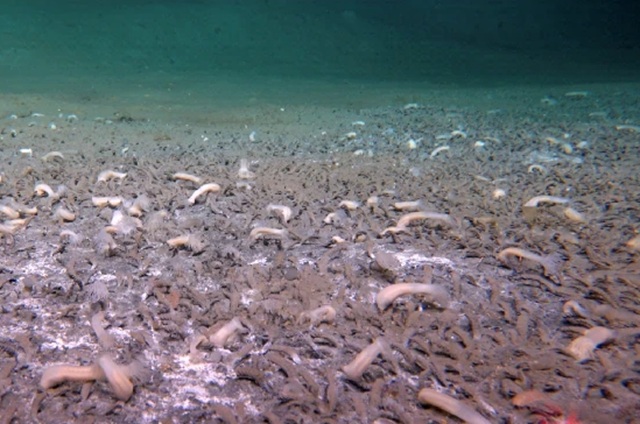
Using the full-ocean-depth manned submersible Fendouzhe, researchers conducted 23 dives between July and August 2024 to explore the trench floors. The first significant discovery, made during dive FDZ 271, was a dense field of frenulate tubeworms found at a staggering 9,533 metres depth—a location now named The Deepest. This site marks the most profound cold seep and chemosynthetic ecosystem yet recorded. The worms were found atop black, organic-rich muds near the base of a geological fault, where methane escapes to the seafloor, fuelling biological productivity.
As the exploration continued, other extraordinary cold-seep fields were discovered along a 2,500-kilometre stretch of the trenches. Among the most prominent were Wintersweet Valley, Dead Valley, and Cotton Field. At Wintersweet Valley, two siboglinid species—Lamellisabella and Polybrachia—dominated the scene, forming colonies that extended for kilometres. These were accompanied by other symbiotic and heterotrophic species including gastropods, polychaetes, amphipods, and echinoderms. At Dead Valley, the presence of deceased siboglinids hinted at the shifting activity of methane seeps, while the adjacent Cotton Field still supported thriving populations, demonstrating the dynamic nature of these environments.
The western Aleutian Trench also revealed complex and biologically rich ecosystems, albeit with a different species composition. Here, large populations of chemosymbiotic vesicomyid clams—such as Abyssogena phaseoliformis and Isorropodon fossajaponicum—were found in deep muddy sediments, sometimes forming distinct patches adjacent to siboglinid colonies. Seep fields like Clam Bed, Blue Marsh, and Icy River were characterised by unique faunal assemblages, including dense aggregations of ampharetid polychaetes and microbial mats, forming diverse ecological mosaics over areas several kilometres wide.
The geochemical analyses performed on sediment cores from these sites further corroborated the biological findings. Methane was found to dominate the hydrocarbon content, with isotopic signatures consistent with microbial methanogenesis via carbonate reduction. These conclusions were supported by high levels of methane saturation in pore waters—far exceeding the solubility limits for the in situ pressures—and the absence of bubbling or gas-phase release, which confirmed the predominance of methane in dissolved and hydrate forms. Additionally, sediments displayed high sulphide concentrations and the presence of ikaite, a form of calcium carbonate hydrate that forms in cold, methane-rich conditions. These chemical markers provide critical evidence for the biogeochemical pathways sustaining life in these depths.
Importantly, the researchers propose a distinct model for cold seep formation in these hadal trenches, which diverges from the mechanisms observed in shallower accretionary prism settings. In the deep trenches, microbial methanogenesis is believed to occur within thick layers of organic-rich sediment, which accumulate rapidly due to surface productivity and frequent downslope sediment flows. The methane then migrates laterally through compressional stress fractures towards the fault zones at the trench base. There, it rises to the seafloor, feeding the chemosynthetic communities. This model explains the widespread and linear distribution of the seep habitats observed during the expedition.
The implications of this discovery are profound. Not only do these findings dramatically expand the known depth range for chemosynthetic life, but they also suggest a more extensive distribution of such ecosystems across the world’s hadal zones. These systems appear to act as energy and nutrient hotspots, not only supporting unique symbiotic life but also bolstering surrounding heterotrophic communities. The presence of both obligate and opportunistic species indicates a complex food web and a possible integration of chemosynthetic productivity into broader benthic ecosystems.
Furthermore, the presence of abundant methane and methane hydrates in these deep trenches introduces new variables into global carbon cycling models. Traditionally, the hadal environment was considered relatively passive in terms of carbon processing, but this study challenges that assumption, presenting evidence that microbial communities in the deep seabed could significantly influence the fate of organic carbon in subduction zones. The ability of hadal sediments to store carbon in the form of methane hydrates for geological timescales offers new insight into carbon sequestration and the broader implications for climate change projections.
This pioneering research opens new avenues for understanding the deep ocean, a realm that remains largely unexplored. The ecosystems discovered in the Kuril–Kamchatka and Aleutian trenches demonstrate not only the adaptability of life in extreme conditions but also the importance of integrating hadal biology into the broader discourse of marine science, carbon dynamics, and Earth’s evolving biosphere. With many trenches around the globe sharing similar geological features, the potential for undiscovered ecosystems beneath the crushing depths remains vast, urging continued exploration and interdisciplinary investigation.