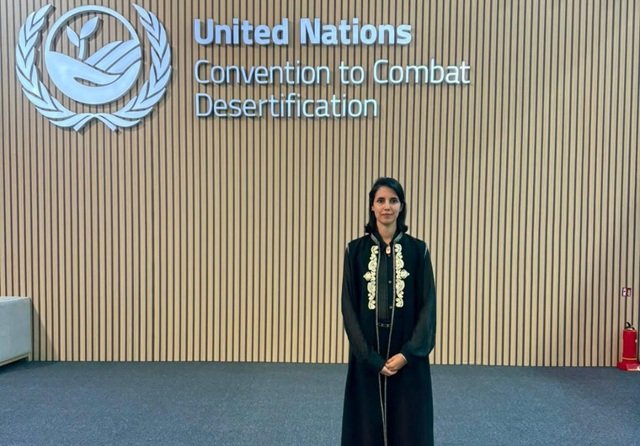
Climate action must begin where its consequences are most immediate: within communities, among farming families, women, young people and others whose livelihoods depend directly on land and natural resources. That is the central message delivered by Souad Agnaou, Vice President of Morocco’s High Atlas Foundation (HAF), at UNCCD COP17 in Mongolia on August 21, 2026.
Agnaou’s message places local participation at the centre of sustainable restoration and climate action. Rather than treating communities simply as beneficiaries of national or international programmes, she argues that they should identify, design and manage the projects intended to address their own environmental, social and economic priorities.
Such an approach, she said, requires investment on a much larger scale, alongside training that enables people to plan and implement projects with women, youth and other members of their communities. The objective is to develop enterprises and initiatives that strengthen the environment while also improving health, education and livelihoods.
Morocco, Agnaou said, provides space and freedom for local community action. But she stressed that this principle needs to be strengthened, both nationally and internationally, with greater urgency. Communities should be empowered to gather inclusively, define their priorities and identify the projects that reflect their highest goals. National and global investment, in turn, should be directed through that participatory process.
The emphasis is not simply on consultation. Agnaou called for projects to be co-created and funded with the people directly, arguing that this would help ensure that investments deliver their maximum benefit to those whose lives are most closely connected to the outcomes.
At COP17, the High Atlas Foundation is also advancing a specific strategy concerning carbon offset credits. At its centre are women, youth and farming families, with an approach that links carbon-related activity to wider community development.
The strategy includes the planting of endemic fruit and forestry tree varieties, locally managed water infrastructure designed for maximum conservation and utility, inter-cultural dialogue and collaboration for human development, opportunities for people living in arid and semi-arid environments, and the strengthening of south-south unity.
For HAF, the issue is therefore not simply how carbon credits are generated, but who benefits from the economic value created by them. Existing and upcoming offset standards, regulatory systems and global purchasers of carbon credits, Agnaou argued, need to recognise and add value to these qualities as part of the response to climate challenges.
The wider concern is that the growing carbon market should not leave the communities undertaking environmental work without a meaningful share of its potential benefits. HAF believes that people experiencing some of the greatest poverty in the world should be able to retain the potential generated by their work and by the expanding carbon-credit market.
Agnaou’s proposal is to direct the value of carbon credits, to the fullest possible extent, towards investments in projects identified and operated by communities themselves. Such an approach, she said, could enable women, youth, people without land, families and groups that have experienced marginalisation over time to improve their lives alongside wider society.
The argument connects climate action directly to inequality. According to Agnaou, global environmental unsustainability is most significantly rooted in the vast inequality that exists both within and among societies. That inequality, she said, forms the basis of the global climatic imbalance.
For HAF, addressing climate change therefore cannot be separated from questions of human well-being. Agnaou called for courageous leadership at both global and local levels and across all sectors, with the well-being of humanity serving as a central measure of the success of public, private and civil missions.
She also stressed the need for accountability. Climate action, in this view, requires institutions and individuals to hold themselves and one another responsible for whether commitments produce meaningful improvements in people’s lives.
The High Atlas Foundation argues that the climate crisis and the preservation of humanity’s best future cannot be sustainably addressed while people remain intensely socially and economically stratified. The proposition places social inclusion alongside environmental restoration as an essential component of climate action.
The ultimate test of COP17 commitments, Agnaou said, should therefore be visible in the lives of the people affected by them. The questions are practical: whether farming families can successfully cope with severe drought; whether women and young people are able to achieve stronger socio-economic and climate initiatives; whether degraded lands are restored by the people who depend upon them; and whether communities are supported in decisions affecting their land and natural resources.
That final measure extends beyond the announcement of commitments. It encompasses the entire process, from identifying priorities to implementing projects, monitoring their progress and evaluating their results.
For HAF, national and international pledges become meaningful only when they are translated into local community projects, accessible financing, long-term partnerships and results that people can experience in transformative ways.
The message from Mongolia is therefore a call to move the centre of climate action closer to the communities expected to carry it forward. For the High Atlas Foundation, the effectiveness of global commitments will ultimately be judged not only by what governments and institutions promise, but by whether those promises enable communities to restore their land, strengthen their livelihoods and participate directly in shaping the future of their natural resources.