Martin Löpelmann, NSDAP membership number 80.525, appealed directly to Adolf Hitler in July 1937. “My Führer!” he began, recalling how he had fought on the “front line” to help conquer the German state for National Socialism. Yet the party he had served for nearly a decade was now preparing to expel him.
Löpelmann had been barred from standing again as an NSDAP member of the Reichstag, while the Reich Minister for Education had retired him from his position as a ministerial official. “This measure hit me as unexpectedly as it did harshly,” he wrote. “Especially since I am only 46 years old.” He asked Hitler to find him another position.
His case, examined in detail by Der Spiegel using records held in the German Federal Archives, illuminates a broader tension within the Nazi Party after its seizure of power in 1933. The regime had rewarded its earliest adherents, known as the “Old Fighters”, but it also demanded something that could be more important than seniority: absolute conformity to the party hierarchy.
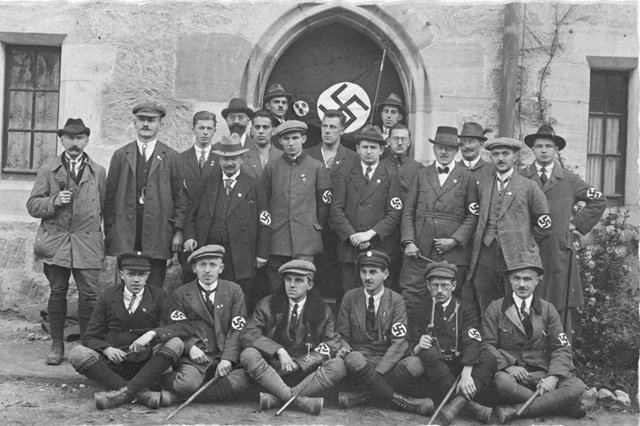
The “Old Fighters” were roughly 300,000 party members who had joined before the NSDAP’s first major electoral successes. Löpelmann had entered the party in April 1928, when it remained a fringe movement that won 2.6 per cent of the vote in the Reichstag election. He joined out of conviction, speaking in pubs and dance halls and attacking political opponents with extreme antisemitic and nationalist rhetoric. He called the Prussian Interior Minister a “Jewish bastard” and a “ridiculous bigwig”, mocked Berlin ministers as a “N**** government” and threatened to hang political enemies after the Nazis took power. His speeches brought repeated fines, and in 1931 he lost his teaching position.
The party rewarded that militancy after 1933. Löpelmann became a ministerial councillor in the Reich Ministry for Science, Education and National Education, where he headed the department for secondary schools. He oversaw the “purging” of grammar schools of Jewish teachers and pupils and simultaneously sat in the Reichstag. For a former secondary-school teacher, it was a dramatic ascent.
Löpelmann was part of a generation for whom the Nazi movement offered ideological certainty, comradeship and enemies. According to political scientist Jürgen Falter, the “Old Fighters” were regarded as the “aristocracy of the party”. Unlike many of the roughly nine million people who joined after 1933 to secure positions or establish themselves with the new rulers, many early members had entered for ideological reasons. Some were fanatics.
Yet the description could be misleading. Most “Old Fighters” were young when they joined, with an average age of between 25 and 28, according to Falter’s analysis of samples from party membership records. Historian Michael Wildt describes this cohort as the “Generation of the Unconditional”, too young to have participated in the First World War. Many became radicalised by what they saw as a missed opportunity for front-line experience during the Weimar Republic.
They experienced political instability and hyperinflation. Hitler, who turned 40 in 1929, appeared energetic and charismatic. The NSDAP and its paramilitary Sturmabteilung, or SA, offered camaraderie and shared enemies. Marches and street fights reinforced bonds between members. More than 90 per cent of the early Nazis were men, many from the lower middle class: craftsmen, skilled workers, farmers and merchants. After the economic crisis began in 1929, many lost their jobs and consequently had still more time to devote to the party.
Their contribution to Hitler’s rise was substantial. Party activists pasted posters and provided security at political meetings. Without this mass of activists at the grassroots, Hitler’s ascent would hardly have been possible.
But victory created a problem. As the Nazis consolidated power in March 1933, applications for party membership flooded the headquarters in Munich. On 1 May 1933, about 1.7 million new members were admitted. The original activists were suddenly a minority within the movement they had helped build.
Many of the newcomers were highly educated: ministerial officials, teachers and professors seeking professional opportunities or hoping to continue their careers under the new regime. Wilhelm Loeper, the NSDAP Gauleiter of Magdeburg-Anhalt, complained that he had to resist the “pressure of numerous party comrades at the feeding trough”. Others denounced “job hunters” and “profit National Socialists”.
The party temporarily stopped accepting new members. It needed qualified people to occupy ministries and public authorities, but it also feared that newcomers might be ideologically unreliable. At the same time, some “Old Fighters” discovered that the revolution they had imagined was not the revolution Hitler intended to deliver.
They had believed in visions of a “people’s community” and a profound transformation involving redistribution. The SA, which was deployed as auxiliary police after the seizure of power, contemplated replacing the Reichswehr. Hitler instead sought the support of established elites in the army and business. In 1934, he used violence against sections of the rebellious SA, killing its leader Ernst Röhm and other political opponents, including dozens of party veterans.
The regime nevertheless sought to reassure the earliest Nazis. The first 100,000 party members who had remained continuously loyal could apply for the Golden Party Badge. Celebrations, commemorative publications and ceremonial marches honoured the so-called Old Guard. Particularly deserving party officials received preferential tickets for Kraft durch Freude cruises to Madeira or Norway.
The message was unmistakable: commitment to the Nazis could bring tangible rewards.
Financial assistance followed. Rudolf Heß promised at the 1936 party rally that none of the “old veterans” should suffer hardship. The party launched a vast employment programme for unemployed members, exploiting its control of public authorities and state-owned enterprises. Thirty thousand found employment at the Reichspost alone. Others entered gas and water utilities, public transport companies and health insurance funds. In Hamburg, local party officials privately referred to some such workplaces as “settling grounds”.
For many, however, the rewards did not resolve their grievances. A 1936 party survey in Gau Hessen-Nassau found widespread dissatisfaction. One member complained: “The old ones are no longer needed, but are constantly being pushed back.” Another said he had been “thrown on the scrap heap”.
Historians Kurt Pätzold and Manfred Weißbecker consequently regarded the “Old Fighters” largely as losers who withdrew from party bodies, “disappointed with the present”. Historian Anja Stanciu, however, has challenged such a generalisation. Her study of more than 100 early Berlin party members found that most advanced after 1933, becoming mayors, Reichstag members or senior figures in institutions such as the Berlin public transport authority and municipal waste collection.
Their careers, Stanciu argues, depended on qualifications, networks and, above all, adaptability. “The careers did not function significantly differently than today or before 1933,” she says. “Those who had the right patrons, were capable, possessed leadership qualities and behaved with self-control had good chances of advancing.”
Löpelmann had many of those advantages. What he lacked was restraint.
He continued criticising the regime after his promotion. He attacked the growing influence of the Hitler Youth and its leader, Baldur von Schirach, another “Old Fighter”. Löpelmann accused the organisation of undermining teachers’ authority and personally attacked von Schirach, accusing him of “hysterical shouting” and calling him an “old maid”, according to a party investigation report.
His conduct violated the Führer principle that governed the party. Subordinates were expected to obey their superiors, and von Schirach stood far above Löpelmann in the hierarchy, with powerful connections to Hitler. Löpelmann was suspended from his offices and, for the second time, lost his job.
The party’s highest court initially recommended a warning, noting his “particularly temperamental manner” had been known since the years of struggle and that he had supposedly acted out of “loyalty to the Führer”. Hitler rejected the recommendation. In 1938, Löpelmann received a letter from the “Chancellery of the Führer of the NSDAP” informing him that Hitler had ordered his expulsion. His party membership book and Golden Party Badges had to be returned.
After 1945, the meaning of that loyalty changed dramatically. Men who had once invoked their low membership numbers and long service to obtain positions and privileges now sought to minimise their involvement. The early members were initially treated by denazification tribunals as “major offenders”, and holders of the Golden Party Badge were subject to particular scrutiny.
Many nevertheless portrayed themselves as misguided idealists who had become disillusioned with Nazi methods after 1933. Löpelmann went further. Before a denazification commission, he presented himself as a victim of the Nazis who had been expelled because of his “opposition”. He even claimed that he had refused to “personally ask Hitler for mercy”. He did not disclose his 1937 appeal to Hitler. The commission therefore concluded that he had undergone a “complete change of political conviction”.
But the old Löpelmann was still visible in his language. When the proceedings dragged on, he angrily condemned “characterless rags” who had already been exonerated and denounced the “worm-eaten political driftwood” that had entered the party after 1937 for “less than honourable reasons”.
The man who had once been expelled for refusing to accept the party hierarchy appeared, even after the fall of the Nazi regime, to regard himself as a better Nazi than those who had followed it more successfully.