For much of the last three decades, China’s rise in Africa has been defined by economics. Its footprint has been visible in the bridges, highways, ports, and power stations financed and constructed under the Belt and Road Initiative (BRI). Through loans, investments, and infrastructure projects, Beijing established itself as Africa’s most prominent external economic partner, eclipsing traditional powers such as the United States, France, and the United Kingdom. Yet, as CTC Sentinel (2025) observes, the narrative is beginning to shift. China is no longer content with being the continent’s banker and builder; it is quietly and increasingly seeking to reposition itself as a security actor, particularly in the domain of counterterrorism.
This evolution is neither accidental nor cosmetic. It reflects China’s desire to complement its economic power with hard security influence, reshape global security norms, and seize opportunities created by the retrenchment of traditional external actors. What was once the preserve of the United States, France, and to some extent Russia, is now gradually becoming an arena where China seeks to play a leading role. As Dr Jason Warner argues in CTC Sentinel (2025), “China is quietly and increasingly pursuing a role as the primary external security actor in Africa, including in the often-fraught space of counterterrorism assistance.” This pursuit has profound implications not only for African states and citizens but also for global security alignments in the 21st century.
Beijing’s motivations for deepening its role in African CT are layered. At the most immediate level, there is a desire to protect Chinese nationals and infrastructure. The BRI has created vast Chinese stakes in African countries, from rail lines in Kenya to energy projects in Nigeria. These assets—and the personnel who run them—have been repeatedly targeted by insurgents and violent non-state actors. A more assertive Chinese security posture is, therefore, partly defensive. Yet protection of assets tells only part of the story. China’s military strategists view Africa through a broader lens: as a theatre for experimentation and capacity-building. As CTC Sentinel (2025) notes, “China, considering an invasion of Taiwan, needs quick, on-the-ground combat experience, and Africa’s conflict-prone pockets offer relatively low-stakes training grounds.” Unlike the United States or even Russia, China has little real combat experience in the modern era. Its deployments have largely been confined to U.N. peacekeeping missions, naval patrols against piracy, and domestic security operations. Africa, with its fragmented insurgencies and multinational operations, offers a chance to test doctrine, logistics, and force projection in relatively permissive environments.
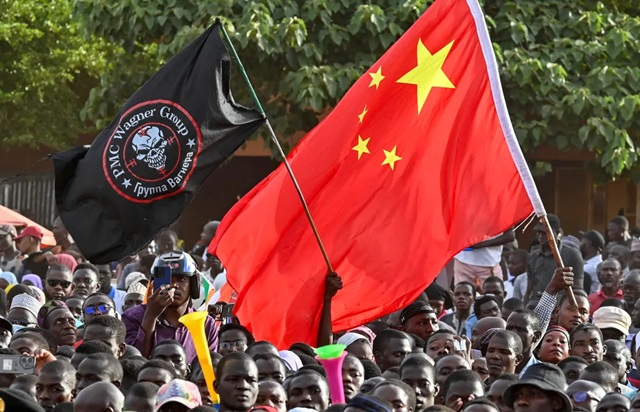
Timing is also critical. Terrorism in the Sahel has reached unprecedented levels, stretching into coastal West Africa and destabilising entire regions. Meanwhile, the traditional external security actors are in retreat. France, once the dominant CT force in the Sahel, has been ejected from Mali, Niger, and Burkina Faso. The United Nations is winding down operations, while the United States has drawn down forces and scaled back training programmes. Russia, through Wagner and its successor, the Africa Corps, has sought to fill the void, but its record has been mixed, often exacerbating insecurity rather than reducing it. Into this vacuum, China sees an opening. As AFRICOM Commander General Michael Langley observed in May 2025, Beijing is “stepping it up and trying to replicate every type of thing, whether it be advise-and-assist type of training and specialised military domains, or putting on exercises like they did in the fall.” In other words, China senses that the moment is ripe: external actors are in retreat, African regimes are desperate for security partners, and Beijing has both the resources and the ambition to step in.
Despite these opportunities, China faces formidable obstacles in its attempt to position itself as a CT actor in Africa. The first challenge is depth of engagement. Beijing has historically pursued a cautious, risk-averse approach to security. Even when its nationals have been attacked in places like Pakistan, its response has been limited: paying ransoms, pressing host governments for better protection, or supplying surveillance technology. As CTC Sentinel (2025) explains, “Its risk-averse, economic-first approach to CT may well prove to be too meagre—all carrot and no stick—to deal with the brutality of the current African terrorism scene.” A second challenge is breadth. Would Beijing be willing to commit significant resources to one particular theatre—akin to U.S. efforts in Somalia or France’s in the Sahel—or would it spread its engagement thinly across multiple regions? To date, China’s military presence has been broad but shallow, involving limited training, technology transfers, and symbolic deployments. Serious CT engagement would require deeper commitments of personnel, logistics, and political capital—commitments Beijing has so far been reluctant to make.
There is also the question of models. China’s most relevant CT experience lies in its suppression of the Uyghur population in Xinjiang and in adjacent Central Asian states. This experience is not easily exportable to Africa, where insurgencies are embedded in complex ethnic, tribal, and religious dynamics. Apart from its role in U.N. peacekeeping missions in Mali and limited training exercises with countries such as Egypt, Beijing lacks the operational expertise that the United States, France, and Russia have acquired through decades of deployments. An “economics-first” CT model—prioritising infrastructure, loans, and training—may provide short-term stability but risks failing in the face of entrenched militant violence. Another uncertainty is Beijing’s willingness to engage with pariah regimes. The Sahel’s most terrorism-afflicted states—Mali, Niger, and Burkina Faso—are now governed by military juntas under the Alliance of Sahelian States. These regimes have expelled Western forces and embraced Russian assistance. For China to play a serious CT role, it would need to partner with such governments, risking reputational costs. Yet history suggests that Beijing is agnostic about regime type. Its appointment of a defence attaché to Niger in February 2025 signals a willingness to engage even with ostracised regimes.
Finally, there is the potential for competition with Russia. While some analysts speak of a “CRINK alliance” (China, Russia, Iran, North Korea), the reality is more opportunistic than cohesive. In the CT space, Russia has become the dominant external partner in Mali and Burkina Faso. Yet, as Warner notes in CTC Sentinel (2025), there is “no clear evidence of any real discord or competition between China and Russia in the military or counterterrorism space.” For now, the two powers appear to coexist, carving out spheres of influence rather than clashing directly.
For African states and citizens, China’s CT push brings both promise and peril. On the one hand, additional resources, training, and infrastructure may enhance state capacity and protect civilians. On the other, there are risks that Chinese involvement could erode sovereignty, weaken governance, and entrench authoritarianism. As CTC Sentinel (2025) cautions, “China’s expanding military presence in Africa risks negatively affecting African nations’ sovereignty by weakening areas of governance, human rights, and regional cooperation.” Globally, the implications are even more profound. By embedding itself in African CT, Beijing is not merely responding to local security needs. It is positioning itself to shape the norms and paradigms of global counterterrorism. Its model—whole-of-state engagement linking economic, diplomatic, and military tools—offers an alternative to the Western CT paradigm dominated since 9/11. As Warner argues, China’s approach reflects a broader ethos of “military political work” (jundui zhengzhi gongzuo), in which all instruments of state power are mobilised for strategic influence.
For the United States, the challenge is acute. Counterterrorism has long been one of the primary means by which Washington maintained military influence in Africa. A deeper Chinese CT presence threatens to erode U.S. access, partnerships, and credibility. Yet, as CTC Sentinel (2025) underscores, Washington’s own retrenchment is facilitating China’s rise: “It cannot both seek to retrench from Africa militarily and diplomatically but also openly fret about losing influence to China globally.” In other words, the United States faces a stark choice: recommit to Africa or accept that China will increasingly fill the void.
Perhaps the most striking development, as Warner highlights in CTC Sentinel (2025), is the inversion of traditional roles. China, once the quintessential economic power in Africa, is now moving into counterterrorism. The United States, long the CT-first power, is pivoting to an economics-first approach. Russia, previously ascendant in the Sahel, is struggling to maintain credibility, while France’s role continues to decline. Turkey, meanwhile, is beginning to surge with its own CT and security initiatives. Whether China will succeed in establishing itself as a credible CT actor remains uncertain. Africa has long been a graveyard for external powers attempting to impose stability. Success, however defined, will require balancing economic incentives with hard security measures, managing reputational risks, and navigating complex regional politics. What is clear is that Beijing’s ambitions in African counterterrorism are not just about Africa—they are part of its wider quest for global influence, legitimacy, and leadership in an era of shifting power balances.